
An African grey will learn your microwave’s finish beep, your husband’s cough, and the exact cadence of your voice calling the dog, and will produce all three back at you inside a month. If you leave for work at eight, she will start calling for you at 7:55. If you close a laptop, she will say “bye” in your voice. Alex, the Congo grey Irene Pepperberg worked with for thirty years, could identify seven colors, five shapes, and quantities up to six, and understood what “none” meant when a tray was empty — that last one is a version of zero-as-a-concept, which most children don’t reliably use until age three or four.[3]
Greys are the most demanding parrot commonly kept as a companion. They are also the ones most likely to reward a serious owner with what feels genuinely like a conversation. Before you decide, you need to know which species you’re looking at, what the real lifespan and cost commitment is, and the two health realities every grey owner ends up learning about the hard way if nobody tells them first.
- Congo and Timneh: two species
- Size, appearance, and lifespan
- What the intelligence looks like
- Temperament and living with a grey
- Diet, calcium, and hypocalcemia risk
- Feather-plucking: what it means
- Daily care: cage, out-of-cage time, sleep
- When to see a vet
Congo and Timneh: two species, not one
For most of the last century, Congo and Timneh greys were treated as two subspecies of a single species. That changed in 2012, when BirdLife International concluded the two were separate species on the basis of genetic, morphological (body shape and skeletal build), plumage, and vocal differences; the IOC World Bird List adopted the split in 2014.[4] Older breed pages, forum threads, and even some pet-shop signage still describe them as subspecies. They aren’t.
Both species are strong talkers. Owners of both will tell you Timnehs tend to start talking earlier (often by six months) and are slightly less prone to the neurotic bouts Congos are known for; Congos have the deeper vocabulary reputation and the larger presence. Neither is universally true of the bird in front of you.
Size, appearance, and lifespan
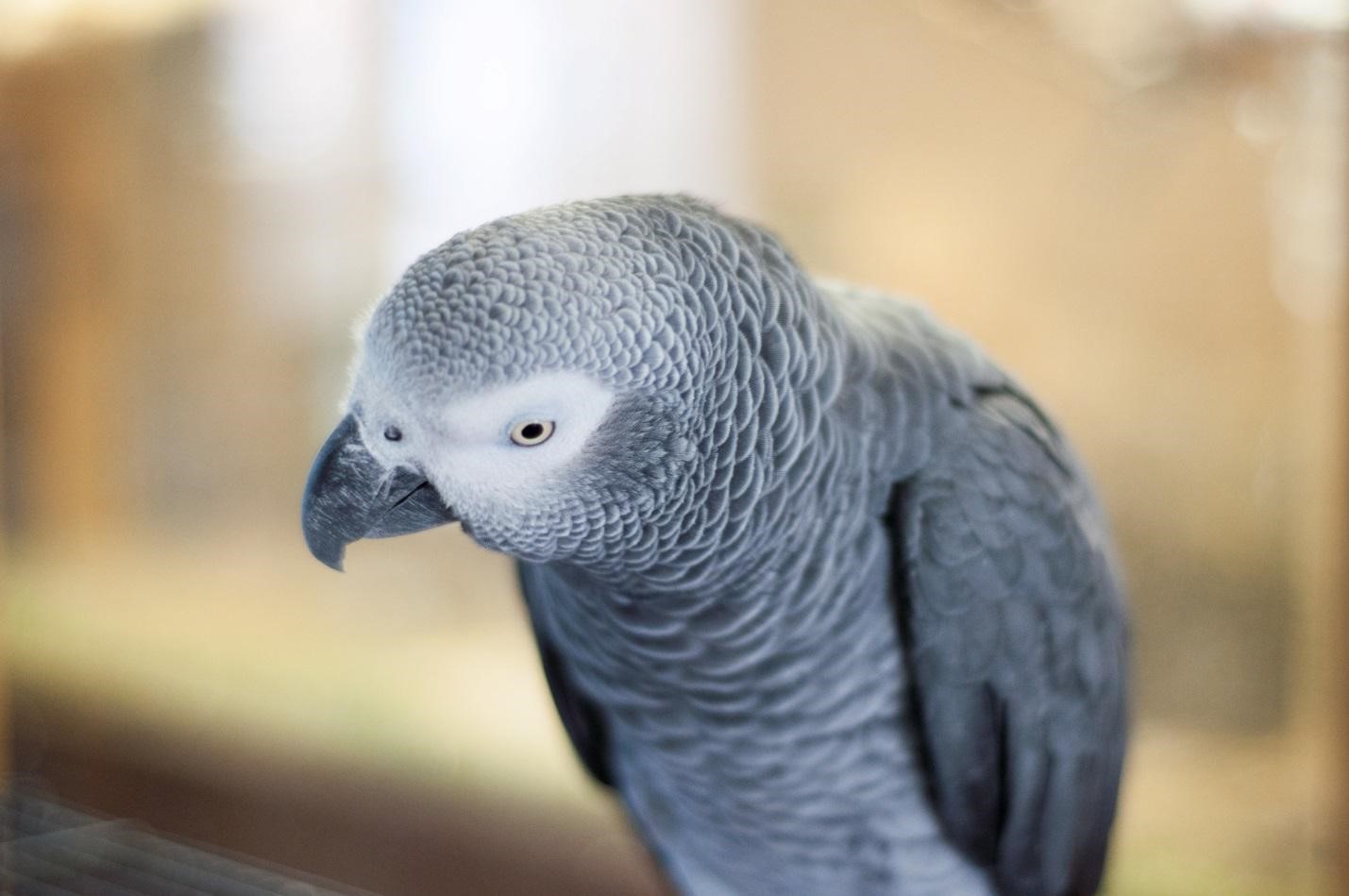
Both species are medium-sized parrots. Lafeber classes the grey simply as “medium-sized,” and VCA describes the Congo as “the larger” and the Timneh as “the smaller, darker” of the two.[1][2] The size difference is noticeable rather than dramatic — a Timneh in the hand feels lighter and stubbier than a Congo, and the two are hard to confuse once you’ve held both — but it isn’t the difference between an Amazon and a cockatiel. A grey’s plumage looks almost powdered up close, with each feather edged in a slightly lighter grey; the “dust” is real feather-sheath powder from active preening and is one of the reasons greys are hard on people with respiratory sensitivities.
Lifespan in captivity is commonly reported as 30 or more years, with individual well-cared-for birds reaching their 40s and 50s.[1][2] Numbers north of that circulate widely on the internet and are not well-supported by veterinary literature. Sixty and seventy-year greys exist as anecdotes; they aren’t the ceiling to plan around. Plan for a bird that will very plausibly outlive the working decades of your career.
What the intelligence looks like
The best-documented grey cognition work is Irene Pepperberg’s thirty-year study of Alex, a Congo grey acquired from a Chicago pet shop in 1977. Over the course of the studies, Alex learned to identify seven colors, five shapes, and quantities from one to six by name; he understood the concepts of same and different; and he could report the color of a shape (“what color square?”) reliably above chance.[3] The published work is worth reading if you’re on the fence about a grey. It’s the honest floor for what the species can do; it isn’t a promise your grey will do it.
What that means at the kitchen-table level is a bird who links words to context. A grey who has heard the word “grape” while eating one will use it to ask. A grey who has been called by name from the next room will call your name back. A grey whose owner sighs before a phone call will sigh, in the owner’s voice, before phone calls of her own.
It isn’t parroting in the dismissive sense; it’s association, and it accumulates over years.
The flip side, and this matters, is that a grey whose owner is anxious becomes an anxious grey. A grey whose owner argues in front of her becomes a grey who screams during arguments. The species reads the room.
Temperament and what greys are like to live with
Greys are not cuddle-parrots. They are reserved, watchful, and often prefer one member of a household to the exclusion of others.[1][2] A grey who lets you scratch her head is a grey who trusts you deeply; a grey who steps up onto a stranger’s hand within a week of that stranger arriving is unusual.
They’re also sensitive to routine. A move, a household change, a new dog, a shift in your work hours: any of it can produce a several-week adjustment in behavior. Owners who understand this build routines their bird can count on and give the bird space to work through the changes she can’t avoid. Owners who don’t tend to end up with a grey who screams, plucks, or shuts down.
Diet, calcium, and the grey-specific hypocalcemia risk
Every pet parrot does better on a formulated pellet base than on a seed diet. Greys are one of the species where the difference is not academic.
Base diet. A high-quality pellet as the majority of daily intake, with fresh vegetables and leafy greens daily, small amounts of fruit, cooked whole grains and legumes as variety, and seed only as an occasional treat.[1][5] Seed-heavy diets in greys are a fast route to fatty liver disease (hepatic lipidosis — fat infiltrating the liver, the same disease overfed geese develop), vitamin A and D3 deficiency, and, distinctively, hypocalcemia (blood-calcium levels dropping below what nerves and muscles need to work properly).[5]
Hypocalcemic syndrome in African greys. Merck flags African greys as “prone to an acute hypocalcemia syndrome that is associated with both hypocalcemia and hypovitaminosis D3”[5] — the plain-English version of that is: a grey on the wrong diet ends up with low blood calcium and low vitamin D3 (the vitamin the body needs to absorb calcium in the first place, the same one human doctors check for osteoporosis and bone-strength problems), and the two together are a signature grey-specific medical crisis. The clinical picture in the avian-veterinary literature is a bird presenting with weakness, ataxia (loss of coordination — she’ll wobble, miss the perch, look drunk), and seizures, often falling off the perch — and greys are, in Merck’s phrasing, more dependent on UVB light than Amazona species (Amazon parrots) to maintain adequate serum calcium (the calcium level in her blood).[5] The syndrome is more common in birds fed all-seed diets, and it’s compounded by inadequate exposure to unfiltered sunlight or full-spectrum UV lighting (a lamp that emits the ultraviolet-B wavelengths the sun does, filtered out by ordinary window glass), which the body needs to make the vitamin D3 that lets it absorb calcium at all.
What to do about it isn’t a home calculation. It’s the reason greys need a diet planned with an avian vet, annual bloodwork that includes ionized calcium (the biologically active fraction of blood calcium — the number that tells the vet whether her body actually has calcium available to use, not just calcium sitting bound to protein where nerves and muscles can’t reach it) in adult birds, and either genuine sunlight exposure or an appropriate full-spectrum UV lamp on a timer. A grey that has a seizure needs an emergency vet, not a supplement off a shelf.
Vitamin A. Greys are also notably prone to vitamin A shortfalls.
Feather-plucking: what it means and doesn’t mean
Greys are among the parrot species most associated with feather-destructive behavior: plucking (pulling whole feathers out at the follicle), chewing (biting through the shaft), or barbering feathers (trimming feathers down to a short stubble, the way a beard-trimmer takes hair down close but not out) to the point of visible skin.[1][2] If you look at rescue listings, a substantial fraction of the surrendered greys are plucking.
What plucking usually is: a signal that something in the bird’s life isn’t working: chronic under-stimulation, chronic loneliness, chronic pain, a nutritional issue, a hidden medical problem, or a household stressor the bird can’t escape. What plucking almost never is: a habit that resolves on its own if you wait. Every avian vet’s first assumption is that a plucking grey needs a full workup: blood panel, feather-follicle biopsy if warranted (a tiny plucked-feather-plus-skin sample sent to a lab to rule out follicular disease and viral causes like psittacine beak and feather disease), a diet review, an environmental review, and often a behaviorist consult. Home remedies (the sprays, the collars, the calming supplements pitched at parrot forums) treat the symptom without touching the cause, and the cause is what determines whether the bird recovers.
The single most important thing a prospective grey owner can know: plucking is common, it’s treatable earlier than later, and it needs a vet the day you notice it. Not the week you notice it.
Daily care: cage, out-of-cage time, sleep
When to see a vet
A new grey should have a well-bird exam with an avian vet within the first month home, and again once a year for a healthy adult, with bloodwork after age five or so. Sooner, and urgently, for any of the following:
Avian vets who see greys are rarer than most owners assume until they need one. If your local search is coming up empty, Vet Corner covers how to find an avian vet and when a televet is enough. Line up an avian vet before you have a sick bird. For greys, that means before the bird comes home.
References
- Lafeber Company. African Grey Parrot (species profile). Lafeber Pet Birds, accessed August 2026. https://lafeber.com/pet-birds/species/african-grey-parrot/
- VCA Animal Hospitals. African Grey Parrots — General Information. VCA, accessed August 2026. https://vcahospitals.com/know-your-pet/african-grey-parrots
- Pepperberg, I. M. The Alex Studies: Cognitive and Communicative Abilities of Grey Parrots. Harvard University Press, 2002. See also Pepperberg lab publications.
- BirdLife International; IOC World Bird List. Split of Psittacus erithacus and Psittacus timneh. BirdLife International 2012 taxonomic review; IOC adoption 2014.
- Merck Veterinary Manual. Nutritional Diseases of Pet Birds and Metabolic Diseases of Pet Birds. Merck & Co., accessed August 2026. https://www.merckvetmanual.com/exotic-and-laboratory-animals/pet-birds/nutritional-diseases-of-pet-birds