

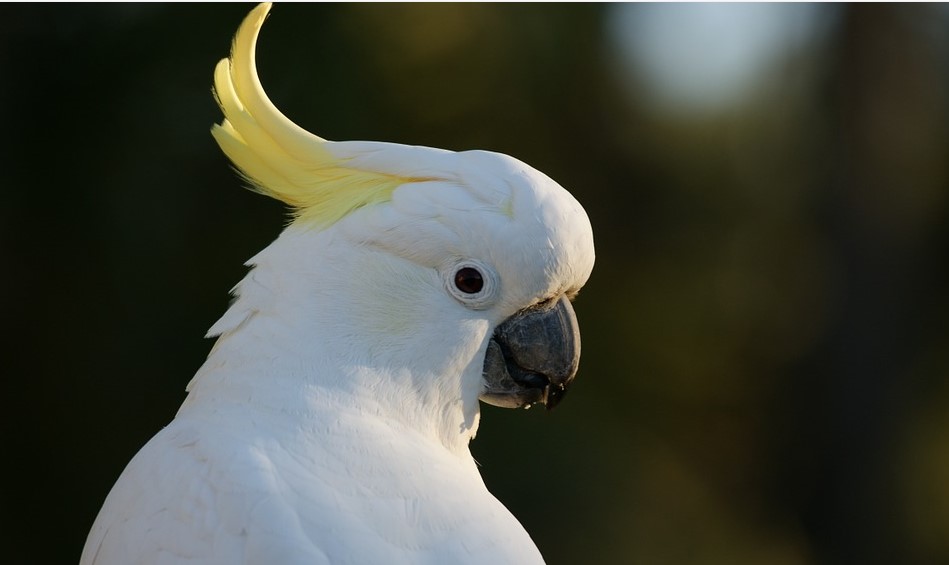
Most pet cockatoos live 30 to 60 years in captivity, with the largest white species regularly reaching their sixties and seventies in good care. The one commonly-kept small cockatoo, the cockatiel, lives 15 to 20 years. Exactly how long yours lives depends on species, diet, veterinary care, and whether the household protects the bird from the household toxins that kill cockatoos suddenly.
- Cockatoo lifespan by species
- Why cockatoos live so long
- What shapes where your bird lands
- Common causes of premature death
- The commitment the number describes
- When to see a vet
Cockatoo lifespan by species
The family Cacatuidae — the cockatoo family — holds 21 recognized species across a wide size range, from the palm-sized cockatiel (roughly the weight of a slice of bread) to the crow-sized palm cockatoo (heavier than a small pineapple).[1] Lifespan varies by nearly a factor of four across the family. A cockatiel and a Moluccan are both “cockatoos” in the household sense; their expected years are as different as a Chihuahua’s and a wolfhound’s.
| Species | Average captive lifespan | Maximum documented | Size | Notes |
|---|---|---|---|---|
| Cockatiel (Nymphicus hollandicus) | 15 to 20 years | ~35 years verified in captivity | Small (~12 in) | The one small cockatoo; the No. 1 pet bird in America per Lafeber.[2][10] |
| Goffin’s cockatoo (Cacatua goffiniana) | 30+ years | 30+ years (Lafeber; individual longevity data thin) | Small-medium (~12 in) | The smallest of the white cockatoos; quieter than umbrellas and moluccans.[3] |
| Galah / rose-breasted (Eolophus roseicapilla) | 30+ years | ~40 years verified in captivity | Medium (12–15 in) | Pink-and-grey; long-lived when well cared for. AnAge lists a 72.8-year captivity report as unverified.[1][6] |
| Umbrella cockatoo (Cacatua alba) | 30+ years | ~70 years per Lafeber | Large (~18 in) | The white cockatoo most owners picture; extremely loud, very demanding.[4] |
| Moluccan / salmon-crested (Cacatua moluccensis) | 30+ years | ~66 years verified in captivity | Large (~20 in) | One of the largest cockatoos; the loudest of the family.[5][11] |
| Sulphur-crested (Cacatua galerita) | 40 to 60 years | ~57 years verified (widely-cited 80+ and 100+ figures are anecdotal; AnAge notes a 73-year report as unverified) | Large (~20 in) | The largest cacatua; long-lived and loud. “Cocky” at London Zoo lived over 57 years.[7] |
| Palm cockatoo (Probosciger aterrimus) | 40 to 60 years | ~56 years verified in captivity | Very large (~22–24 in) | Do not do well in captivity; specialist-only.[8] |
The internet numbers you’ll see for cockatoos (“up to 100 years”, “up to 120 years”) are anecdotal and unsupported. The single verified record for a sulphur-crested cockatoo, “Cocky” at London Zoo, is over 57 years — AnAge’s maximum-captivity longevity for the species.[7] Plan for a well-lived bird to reach its sixties. Anything beyond that is a happy surprise, not a projection.
Why cockatoos live so long
Two reasons. The first is body size and metabolism: bigger birds, all else equal, live longer than smaller ones, and the large cockatoos are among the biggest parrots kept as companions. The second is reproductive biology. Cockatoos pair for life in the wild, don’t breed until several years old, and can be reproductively active into their forties.[8] Species with slow reproductive cycles tend to be long-lived; species that fledge fast and die young — the small finches and most songbirds, who leave the nest within weeks of hatching and often see fewer than five birthdays — don’t.
What that means in practice for an owner is straightforward. A cockatoo bought at your college graduation can very plausibly outlive you. Estate plans for parrots aren’t paranoid; they’re a normal part of responsible ownership of any of the large white cockatoos.
What shapes whether your bird hits the top or bottom of the range
Five factors do almost all of the work. Genetics is the one you can’t change. The other four are yours.
Common causes of premature death
If a pet cockatoo dies well before its species average, one of these is usually why.
A positive PBFD test in a two-year-old bird reframes what a “sixty-year lifespan” actually means for that household, since many affected cockatoos are lost to complications well before their species average.
The commitment the number describes
A number on a chart doesn’t feel like a commitment. Six decades of daily out-of-cage time, twice-daily fresh food, weekly cage cleaning, annual bloodwork, and a bird whose emotional state responds to yours does. The large white cockatoos are among the parrots most often surrendered to rescues, and the reason is almost always the mismatch between the fantasy at purchase and the reality of a fifty-year-old bird with the emotional needs of a two-year-old child.
None of this is a reason not to keep a cockatoo. It’s a reason to keep one eyes-open, with an estate plan, a working relationship with an avian vet, and a household that has room for the bird’s needs.
A cockatoo kept that way is remarkable company for the length of a marriage. A cockatoo kept any other way rarely lives to see its species average.
When to see a vet
Once a year for a well-bird exam and baseline bloodwork on any adult cockatoo. Sooner for any of the following:
Avian vets who see cockatoos are rarer than most owners assume until they need one. If your local search is coming up empty, Vet Corner covers how to find an avian vet and when a televet is enough. Line up an avian vet before you have a sick bird. With a bird that may live longer than most household relationships, that appointment is worth making the week the cockatoo comes home.
References
- Lafeber Company. Cockatoo (family overview). Lafeber Pet Birds, accessed August 2026. https://lafeber.com/pet-birds/species/cockatoo/
- Lafeber Company. Cockatiel (species profile). Lafeber Pet Birds, accessed August 2026. https://lafeber.com/pet-birds/species/cockatiel/
- Lafeber Company. Goffin’s Cockatoo (species profile). Lafeber Pet Birds, accessed August 2026. https://lafeber.com/pet-birds/species/goffins-cockatoo/
- Lafeber Company. Umbrella Cockatoo (species profile). Lafeber Pet Birds, accessed August 2026. https://lafeber.com/pet-birds/species/umbrella-cockatoo/
- Lafeber Company. Moluccan Cockatoo (species profile). Lafeber Pet Birds, accessed August 2026. https://lafeber.com/pet-birds/species/moluccan-cockatoo/
- AnAge Database of Animal Ageing and Longevity. Eolophus roseicapilla (Galah) longevity, ageing, and life history. HAGR/AnAge, accessed August 2026. https://genomics.senescence.info/species/entry.php?species=Eolophus_roseicapilla
- AnAge Database of Animal Ageing and Longevity. Cacatua galerita (Sulphur-crested cockatoo) longevity, ageing, and life history. HAGR/AnAge, accessed August 2026. https://genomics.senescence.info/species/entry.php?species=Cacatua_galerita
- AnAge Database of Animal Ageing and Longevity; World Parrot Trust. Probosciger aterrimus (Palm cockatoo) longevity and life history. HAGR/AnAge and World Parrot Trust, accessed August 2026. https://genomics.senescence.info/species/entry.php?species=Probosciger_aterrimus
- Merck Veterinary Manual. Nutritional Diseases of Pet Birds. Merck & Co., accessed August 2026. https://www.merckvetmanual.com/exotic-and-laboratory-animals/pet-birds/nutritional-diseases-of-pet-birds
- AnAge Database of Animal Ageing and Longevity. Nymphicus hollandicus (Cockatiel) longevity, ageing, and life history. HAGR/AnAge, accessed August 2026. https://genomics.senescence.info/species/entry.php?species=Nymphicus_hollandicus
- AnAge Database of Animal Ageing and Longevity. Cacatua moluccensis (Moluccan cockatoo) longevity, ageing, and life history. HAGR/AnAge, accessed August 2026. https://genomics.senescence.info/species/entry.php?species=Cacatua_moluccensis