

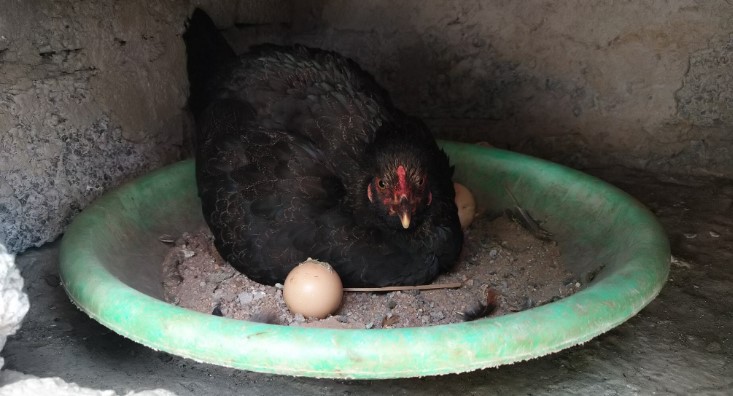
Egg binding in birds may sound benign, but far from it. It is a serious medical condition that’s often fatal if your chicken doesn’t receive emergency medical treatment.
If left untreated, an egg-bound hen often dies within 24 to 48 hours — sometimes faster if the egg has already broken inside her and caused peritonitis, sometimes longer for a robust hen with only partial obstruction. You need to know how to tell if a chicken is egg-bound and what to do in that situation.
Here’s everything you need to know about it.
What Is Egg Binding?
Chickens “in lay” usually lay an egg once every 25 hours – give or take. Egg binding describes a situation where an egg gets stuck somewhere in its oviduct, usually between the uterus and cloaca.
The cloaca is the vent through which a chicken expels eggs and feces. When an egg is ready to pass, the cloaca seals the intestinal opening to prevent the eggs from getting covered in poop as they exit the vent.
The next logical question would be – Can a chicken die from being egg bound? The short answer is – yes, they can.
When an egg gets stuck in the oviduct and is unable to pass, the intestinal opening remains sealed for the entire duration. If an egg bound chicken can’t poop within 24 to 48 hours, they’ll likely die.
Vent prolapse is yet another effect of egg binding where the vent hangs out of the chicken’s posterior. When this happens, the ruptured yolk of a developing egg may get deposited within the hen’s coelom (body cavity).
This may cause a condition known as egg yolk peritonitis, where the yolk material becomes infected with bacteria – the most common being E. coli. This could then spread into the bloodstream, causing a secondary and potentially life-threatening infection in major organs like the heart, liver, and kidneys.
Why Do Chickens Get Egg Bound?
Several factors can contribute to the onset of this condition in chickens. Hens on a high-protein diet are susceptible to egg binding. Dehydration, low-quality feeds, intestinal worm infestation, and even stress can all cause a chicken in lay to become egg bound.
In other cases, it could be due to calcium deficiency. Calcium is necessary for the proper muscle contraction required to move the egg along the oviduct before it is finally expelled through the vent.
Even a large double yolk egg that’s too large to pass can lead to egg binding in chickens. Other potential causes include:
- An infection in the oviduct
- Disturbance during the laying process
- Egg retention due to insufficient nesting areas
- Genetics
- Misshapen eggs
- Obesity (causes the muscles to become weak due to inactivity)
- Elderly chickens
- Premature layers (when a chicken starts laying eggs before its body matures)
How to Tell If Your Chicken Is Egg-Bound
Look for the combination of a hen who was laying regularly and has suddenly stopped, plus visible straining without producing an egg, plus a change in how she is standing and moving. Any one of those signs alone can point to something else; together they are the classic egg-bound picture, and the sooner you recognize it the more options you have.
Behavioral tells. She leaves the nest box repeatedly without laying, or she stays in it for far longer than usual with nothing to show. She sits or squats on the coop floor rather than perching. She strains with her tail lifted, sometimes with visible pulses of effort you can time. She walks with her legs held apart in a wide, penguin-like stance, or she is reluctant to walk at all. Her feathers are fluffed and she looks hunched. Her breathing is labored, faster and shallower than her flockmates’ — the mass of a stuck egg presses forward against the air sacs, making every breath take more work.
Physical check. With the hen calm and gently supported, feel low on her abdomen just forward of the vent. An egg is felt as a firm, rounded mass in the lower belly; it is distinct from the softer, more diffuse feel of a hen who is simply full. If you are not confident with palpation, do not force it — the exam itself can be stressful, and a vet’s palpation is more informative than an uncertain one done at home. The vent area may look visibly swollen, and in some cases you can see the tip of the egg at the vent opening.
The timing test. Ask yourself: has she passed an egg in the last 24 hours? A hen who has been laying regularly and has now gone quiet, showing straining and any of the behavioral signs above, is highly suspect for egg binding. First-time layers and older hens past their peak are the two populations that see it most; if your hen fits either profile, the timing test moves egg binding to the top of the list.
What else can look like egg binding. Two conditions mimic the presentation and are worth ruling in or out with a vet’s exam before assuming egg binding is the diagnosis. Ascites (water belly — covered on our ascites page) presents with a soft, distended belly and a wider stance but usually without the straining behavior; the belly feels squishy, not firm. Egg-yolk peritonitis follows a broken internal egg and produces yolk material in the coelom, often with severe illness that comes on faster than typical egg binding. Reproductive-tract tumors are more common in older hens and can produce a similar hunched-and-straining picture without a passable egg being present at all. All three of these are vet-diagnosed, not home-diagnosed — which is why an egg-bound hen who has not responded to safe first-response care goes to a vet, not through another cycle of home care.
When you can be reasonably sure. A hen with the classic combination — recent normal laying, sudden stop, straining behavior, wide stance, fluffed feathers, palpable firm mass — is egg-bound until proven otherwise, and the safe first-response steps in the section below are appropriate to start while you make the vet call. If any of those signs are missing, or if she is severely off (unresponsive, unable to stand, cold to the touch), skip home care and get her to a vet directly.
What to Do If You Think She’s Egg-Bound
The response is a short window of safe first-response care while you make arrangements with a vet, not an indefinite home protocol. An egg-bound hen typically dies within 24 to 48 hours if the egg is not passed — sometimes faster if the egg has already broken inside her and caused peritonitis. What follows is what you can safely do in the first hour or two; the moment she does not respond, it is a vet call.
Step 1: Warm Epsom-salt bath
Fill a shallow tub or sink with a few inches of warm water (about 100°F / 38°C — comfortable-warm to your wrist, not hot). Add a handful of Epsom salts and stir to dissolve. Lower the hen in so the warm water covers her lower abdomen and vent for about 15 to 20 minutes; support her so she can stand rather than swim, and hold her calmly so she is not fighting to escape. The warmth relaxes the oviduct muscles and can help the egg move; the Epsom salts add mild anti-inflammatory support. Dry her thoroughly afterward with a soft towel so she does not chill.
Step 2: Lubricate the vent
Apply a small amount of water-based lubricant (KY jelly or a comparable product) around the vent opening and just inside the vent lip. Do not push any object into her cloaca and do not attempt to reach the egg. The goal is external lubrication so that when the egg does start to move, the exit path is smoother.
Step 3: Warm, dark, quiet enclosure with calcium and hydration
Place her on a warm towel in a large box or dog crate in a dark, quiet room. A heating pad set on low under half the crate lets her move to a warmer or cooler side as she needs; do not put the heating pad under the full floor of the crate. Give her a dose of liquid calcium (a crushed human calcium carbonate tablet dissolved in warm water and syringed slowly into her beak, or a poultry liquid calcium product per label) — calcium is what the oviduct muscles need to contract effectively, and low-calcium hens often cannot pass the egg without it. Add a splash of Nutri-Drench or a similar poultry electrolyte for hydration and energy support.
Give her about an hour, up to two. If she passes the egg in that time, monitor her closely afterward — keep her warm and quiet, offer soft food and fresh water, watch for a second egg or for signs of prolapse or peritonitis over the next several days, and let her recover before returning her to the flock. If she does not pass the egg within 1 to 2 hours, this becomes a vet call, not a repeat cycle. Repeating the home protocol for many hours delays the vet visit into the 24-to-48-hour window when the hen starts dying; the home protocol is a first response, not a stall.
Step 4: Call the vet — this is not a home step
If the first three steps don’t work, this is a vet visit — not the next home step. Puncturing an egg inside a live hen and removing broken pieces is a veterinary procedure performed with sedation, sterile instruments, and either direct visualization or endoscopy. A home version risks: retained pieces in the oviduct causing peritonitis (the same infection process — sepsis, organ failure — that a healthy hen recovering from an intact stuck egg would never face); uterine wall perforation from a needle used blindly; massive hemorrhage from the well-vascularized oviduct; egg yolk splashed into the body cavity causing egg-yolk peritonitis, which PoultryDVM notes has a poor prognosis without prompt vet care.
If you have completed Steps 1 through 3 and the hen still has not passed the egg after an hour or two, that is the signal to get her to a vet, not the signal to escalate the home protocol. A vet can give an injectable that stimulates oviduct contractions (oxytocin or its avian equivalent, arginine vasotocin), administer calcium alongside it if she is deficient, sedate her for safe manual assistance if the egg is close to the vent, and perform ovocentesis (drain the egg contents through a fine needle under sedation, then carefully remove the collapsed shell) if the egg is truly stuck — the same procedure done safely with the tools and training a home attempt does not have. If cost or access to a local avian vet is the barrier, our Vet Corner resources cover licensed televet options that can get eyes on her the same day.
Everything in Moderation
Egg binding can be a nightmare for both the hen and the owner. If you’re wondering how to prevent egg binding, all you have to do is ensure that you feed your chickens a healthy diet that’s rich in calcium.
Offer oyster shell or crushed eggshells free-choice in a separate dish, not mixed into the daily feed — heavy layers self-regulate their calcium intake when it is available on demand, while non-layers will not over-consume it. This is the standard poultry-nutrition approach to calcium supplementation for backyard flocks.
Go easy on the protein as well. This will ensure they lay regular-sized eggs that can pass through their oviduct easily.
For more information on bird health, see how to talk to a licensed avian vet online, including options when no local vet sees birds.
References
- Merck Veterinary Manual. Reproductive Diseases of Pet Birds. Merck & Co., accessed August 2026. https://www.merckvetmanual.com/exotic-and-laboratory-animals/pet-birds/reproductive-diseases-of-pet-birds
- Merck Veterinary Manual. Egg Peritonitis in Poultry. Merck & Co., accessed August 2026. https://www.merckvetmanual.com/poultry/disorders-of-the-reproductive-system-in-poultry/egg-peritonitis-in-poultry
- PoultryDVM. Egg binding in Chickens: Signs, Treatment & Prevention. Accessed August 2026. https://poultrydvm.com/condition/egg-binding
- The Chicken Chick. Chicken Egg Binding: Causes, Symptoms, Treatment, Prevention. Accessed August 2026. https://the-chicken-chick.com/chicken-egg-binding-causes-symptoms/