
In this article
- Read the body language before you read the cause
- Find your problem: jump to the pattern
- Biting: Fear
- Biting: Cage territoriality
- Biting: Hormonal aggression
- Biting: Overstimulation
- Biting: Jealousy and rivalry
- Biting: Attention-seeking
- Screaming: Flock calling
- Screaming: Attention-seeking
- Screaming: Boredom
- Screaming: Hormonal
- Screaming: Illness or pain
- When it’s medical, not behavioral
- What never works
- The core principle
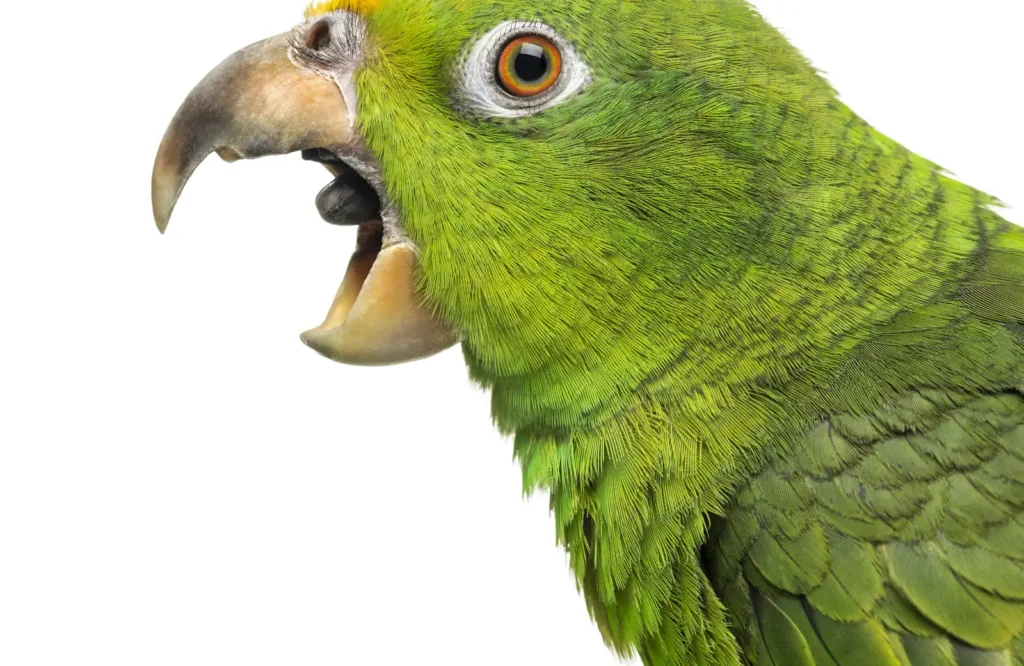
Every conure bites and every conure screams eventually. The question that matters is why: a bite driven by fear is a different problem than one driven by cage territoriality, and a scream that’s a flock-contact call needs a different response than one that’s been shaped by attention-reinforcement. Generic advice (“just ignore it,” “spray with water,” “cover the cage”) makes some root causes better and other root causes dramatically worse.
This guide is a diagnostic tree. Read your bird’s specific pattern, find the root cause that matches, and apply the intervention for that cause. Two parallel tracks, biting and screaming, with cross-references where the same underlying issue drives both.
If the behavior started suddenly, without a change in environment, in an adult bird that used to be gentle, skip to When it’s medical first and rule that out before working through the behavioral framework. Sudden aggression in a previously-friendly bird is often the first sign of pain or illness.
For setup and trust-building context, our conure care guide covers the weeks-two-through-four target-training window where most later behavior problems either get prevented or planted. For lifespan and species-difference reasoning, see our conure lifespan guide.
Read the body language before you read the cause
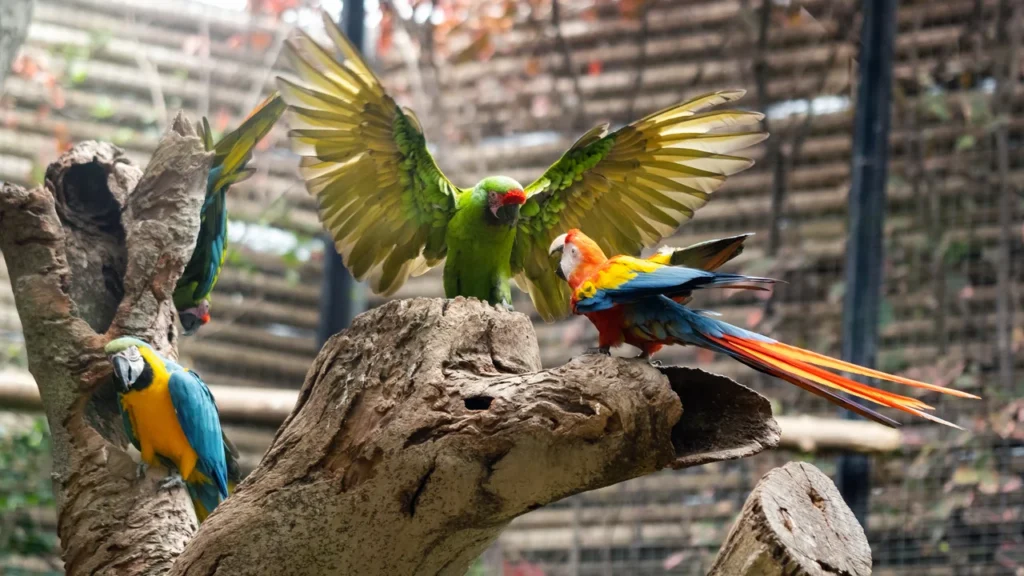
Bites and screams both have telegraphs. Owners who miss the telegraphs get bitten by “unpredictable” birds; owners who read them accurately rarely get bitten at all. Learn these first.
Pinned eyes. The pupil rapidly contracts and dilates, sometimes several times per second. Depending on other body language it signals excitement, aggression, or intense focus. Never reach for a bird with pinned eyes unless you know the surrounding context is play; assume bite risk.
Slicked-down feathers. Feathers held tight against the body. Fear, alertness, or aggression. A conure whose feathers are slicked down is not in a mood to be handled.
Flared tail feathers. Common in Aratinga conures (sun, jenday, nanday) during excitement or aggression. Combined with pinned eyes, it means “back off.”
Puffed body feathers, held for more than a few seconds. Not to be confused with a brief post-preen fluff. Sustained puffing is either illness (see medical section) or a display in a hormonal bird.
Wings held slightly out from the body. Territorial display. Common in cage-territorial birds when a hand approaches the cage.
Beak grinding. Contented, sleepy. The opposite of a warning. If your conure is beak-grinding, it is not about to bite.
Vocalizations before a bite. Growling in green-cheeks, harsh chatter in Aratingas. If you hear it and keep moving your hand toward the bird, you are asking for the bite.
Reading these signals is 80% of preventing behavior problems. The bird is telling you what it will do; the intervention is not to override the signal but to change the conditions that produced it.
Find your problem: jump straight to the pattern
If you already recognize what your bird is showing, go direct.
| Biting | Screaming |
|---|---|
| Fear: new or rehomed bird, retreats before biting | Flock contact call: dawn, dusk, when someone leaves the room |
| Cage territoriality: fine outside the cage, bites when a hand enters | Attention-seeking: sustained, stops when you enter the room |
| Hormonal aggression: seasonal, nest behavior, favored-person biting | Boredom and under-enrichment: long stretches alone, few toys |
| Beaking and overstimulation: young bird, mouthy exploration turning hard | Hormonal frustration: paired with nest behavior, seasonal |
| Jealousy and rivalry: bites when preferred person interacts with someone else | Illness or pain: sudden change in a previously normal bird |
| Attention-seeking: small bite, big reaction, pattern repeats |
Sudden change in a previously stable adult bird? Rule out medical first. Interventions that get widely recommended but make things worse are covered in what never works.
Reading these signals is 80% of preventing behavior problems.
TRACK 1: Biting
Root cause 1: Fear
The pattern. New bird, rehomed bird, or a bird that has been grabbed, chased, or forcibly handled recently. Bites happen when a hand enters the cage or approaches the bird. The bird retreats before biting. Feathers slick down, body posture shrinks small, sometimes the bird tries to escape upward before turning to defend.
Why it happens. Fear-driven biting is defensive, not offensive. The bird believes the hand is a threat and is doing the parrot-equivalent of “get away from me.” Punishment for the bite (yelling, cage-covering as consequence, tapping the beak) makes the fear worse and reinforces the pattern.
Intervention. Restart the trust window. Hand stays outside the cage. Voice stays quiet and low. Approach at bird’s-eye level or lower, never from above. Offer millet or a favorite treat between the bars, letting the bird come to your hand rather than moving your hand to the bird. Target training as described in the conure care guide is the fastest reliable way through: the target dowel does the approach so your hand doesn’t have to. Expect two to eight weeks of consistent work with a bird whose fear pattern is fresh, and three to six months for a bird whose fear has been reinforced over years.
What NOT to do. Do not “just get it over with” and grab the bird. Do not tower over the cage. Do not spray, cover as punishment, or shake the cage. These make fear biting worse and can produce a bird that bites unpredictably for the rest of its life.
Root cause 2: Cage territoriality
The pattern. The bird is fine on a play stand, a shoulder, or a perch outside the cage. Bites specifically when a hand reaches into the cage (for food, water, or the bird itself). Often worst in the morning and evening. Green-cheek conures develop this pattern more often than any other conure species; sun and jenday conures develop it too, later.
Why it happens. The cage is territory. In the wild, a nest cavity is defended aggressively; the bird’s brain reads a hand reaching into its cage the same way it reads a snake reaching into a tree hollow. Cage territoriality is a normal behavior amplified by two owner-side conditions: doing all handling at the cage (which trains the bird to expect a fight there) and letting the bird spend most of its time inside the cage (which raises territorial investment).
Intervention. Move the handling location. Ask the bird to step up onto a target dowel or a portable perch offered at the cage door, never reaching inside for the bird itself. Once out, do all interaction on a play stand, a T-perch, or a designated bird area elsewhere in the room. Return the bird to the cage by having it step off, not by putting a hand inside. Refresh food and water when the bird is out of the cage, not when it is inside. Within a few weeks the cage territoriality softens because the bird has stopped being asked to defend it.
What NOT to do. Do not force the issue with a towel or a glove. Do not try to “show the bird who’s boss”: this concept is a dog-training myth that does not apply to parrots and produces bird-owner relationships that never recover. Do not withhold food to make the bird come out of the cage.
Root cause 3: Hormonal aggression
The pattern. Adult bird, seasonal or year-round pattern that comes and goes. Increased territoriality, cage possessiveness, sudden strong bites of “the wrong” household member while remaining sweet with the “preferred” person. Hens may become nest-focused, shredding paper or targeting dark cavities; both sexes may regurgitate for a favored person, mirror, or toy. Often correlates with spring and long daylight hours.
Why it happens. Reproductive hormones drive the behavior. Long daylight (household lights extending “day” past 8-9 PM), calorie-dense food, warm nesting spots (blankets, huts, cage corners), and physical stimulation of the back or tail area all elevate hormone levels. In hens, the specific downstream risk is chronic egg-laying and egg binding; see egg binding in hen birds for the medical side.
Intervention. Reduce the environmental drivers rather than “correct” the bird. Enforce 10-12 hours of dark on a consistent schedule with cage cover. Remove huts, tents, or dark cavities. Reduce petting to head-and-neck only: no back-stroking, no tail-touching. Cut calorie-dense treats (nuts, seeds, fruit) and re-emphasize vegetables. If the bird has a preferred person, briefly reduce that person’s interaction and increase the “unfavored” household member’s engagement (target training, treat delivery) to rebalance the bond.
What NOT to do. Do not respond to hormonal biting with equal intensity; the bird is already dysregulated and matching intensity escalates. Do not add a mate to “fix” the hormones. A paired conure will lay eggs, and egg-binding risk goes up, not down. Do not ignore chronic laying in hens; involve your vet if the pattern doesn’t break within a few weeks of environmental changes.
Root cause 4: Overstimulation and beak-mouth exploration
The pattern. Young bird, high-energy interaction, out-of-cage play. Bites feel more like hard chomps than defensive strikes. Often happens when the bird is climbing on the owner’s hand, shoulder, or clothing. The bird does not retreat before biting; it initiates.
Why it happens. Young conures explore with their beaks the way puppies explore with their mouths. A hand that flinches, yells, or shakes off a beaking bird provides exciting feedback that makes the behavior more likely, not less. This is where “beaking” becomes real biting.
Intervention. Do not reward the intense feedback the bird is looking for. When the bird beaks harder than is comfortable, calmly return the bird to a perch or a play stand for 30-60 seconds: a brief “time-out” that removes the interaction the bird was seeking. Return to interaction when the bird is calm. Consistency is everything; every household member has to apply the same response. Redirect beaking energy into destructible foraging toys during out-of-cage time so the beak has something legitimate to work on.
What NOT to do. Do not thump, tap, or flick the beak. Do not blow in the bird’s face (this becomes a game). Do not yell. For many conures, a loud reaction is a reward, not a deterrent.
Root cause 5: Jealousy and rivalry
The pattern. The bird bites specifically when the preferred person is interacting with another household member, another pet, or another bird. Fine otherwise. Often worst on shoulders and near the face.
Why it happens. Bonded conures form pair-bonds with their preferred person, and pair-bonded parrots defend the bond against perceived rivals. The behavior mirrors what a wild bonded pair does when a third bird approaches; it is not a training failure but a species-normal drive being aimed at the wrong target.
Intervention. Broaden the bond rather than punish the jealousy. Have other household members do the treat delivery, the target training, and the fun interactions. Reduce the preferred person’s role in high-value interactions until the “third party” is neutral rather than a rival. Remove the bird from the shoulder before the interaction with another person begins. A bird on a perch nearby is much less likely to bite a face than a bird on a shoulder six inches from the target.
What NOT to do. Do not scold the bird after a jealousy bite. Do not put the bird back on the same shoulder immediately. Do not force interaction with the “unfavored” person while the bird is agitated.
Root cause 6: Attention-seeking (learned)
The pattern. The bird bites, the owner reacts dramatically (yells, jumps, drops the bird), and the pattern repeats and intensifies. Often develops in households with young children or in bonded pair-of-people situations where reactions are consistently big.
Why it happens. Behavior that is reinforced repeats. If a small bite produces a big reaction, the bird has learned a lever it can pull to get instant, intense engagement. This is the same mechanism that makes attention-seeking screaming worse (covered below).
Intervention. Reduce the reinforcement. When bitten, respond with the least reaction that lets you safely put the bird back on a perch: no yell, no drama, just a calm return-and-walk-away. Coordinate with every household member; if the bird gets a big reaction from one person, the behavior stays reinforced overall. Continue to interact enthusiastically when the bird is calm and not biting. The goal is not to remove attention, but to remove the specific pattern where biting produces attention.
What NOT to do. Do not yell. Do not chase, grab, or drop the bird. Do not lock the bird in the cage as punishment for a bite. The bird does not connect the punishment to the bite, and the cage becomes an aversive place.
TRACK 2: Screaming
Root cause A: Flock contact calling (normal)
The pattern. Bursts of loud calling at dawn, dusk, and when someone leaves the room. Two to ten seconds per burst; not sustained across long periods. Bird stops when the household member returns or when the household is visibly settled together.
Why it happens. This is the species-normal flock-contact call. Wild conures call to locate flock members throughout the day, especially at flock-cohesion moments (morning departure, evening return, roosting time). Captive conures do the same thing with their human flock. This is not a behavior problem; this is a conure being a conure. Sun, jenday, and nanday conures do it louder and more insistently than green-cheeks.
Intervention. Do not try to eliminate it. You cannot; it is hardwired. What you can do: answer the call. When you leave the room, call back with a whistled response the bird has learned to recognize. This satisfies the flock-cohesion drive with less volume than a full contact scream. Feed a small treat, cover briefly with a light cloth, or drop toys into the cage during the transition minutes to redirect. Recognize that if you chose a sun or jenday conure, this is the sound of the choice, not a training gap.
What NOT to do. Do not spray with water, do not cover the cage as punishment, and do not yell. These make flock calling worse because they raise the bird’s arousal and confirm its sense that the flock is unstable.
Root cause B: Attention-seeking (learned)
The pattern. Sustained screaming, sometimes hours long, that stops when the owner enters the room or gives attention and starts again when the attention withdraws. Often developed over months or years; the owner reacted to early flock-call screaming with attention, and the bird learned the lever.
Why it happens. Same mechanism as attention-seeking biting. Any attention (including negative attention like yelling or approaching to cover the cage) reinforces the screaming. Well-meaning owners often make this worse for months without realizing they’re the source of the pattern.
Intervention. This is where genuine behavioral extinction is the answer, and it requires household consistency. Reward quiet: enter the room, give attention, deliver treats when the bird is not screaming. Ignore screaming: do not enter the room, do not respond, do not make eye contact. Consistency is non-negotiable; a household where three members ignore and one member responds keeps the pattern alive indefinitely. Expect an “extinction burst”: a phase where the screaming gets louder and longer before it subsides. This is normal and does not mean the intervention is failing; it means the bird is testing whether the old lever still works. Total resolution takes weeks, not days.
What NOT to do. Do not respond intermittently. Intermittent reinforcement is the strongest reinforcement pattern known in behavior science, and it makes the screaming permanent. Do not “cave” during the extinction burst. Do not punish the screaming with cage-covering or water; this reinforces it if any attention component reaches the bird.
Root cause C: Boredom and under-enrichment
The pattern. Screaming during long stretches of the day when the owner is at work or in another room. Bird has few toys, limited out-of-cage time, and minimal foraging opportunities. Often paired with feather-destructive behavior developing in parallel.
Why it happens. Conures are intelligent flock animals whose wild days include foraging, flock interaction, flight, and problem-solving. A bird with none of those has nothing to do; screaming becomes one of the few available activities. This is different from attention-seeking. The bird is not seeking your attention specifically; it is seeking engagement of any kind and has learned that noise is one form of it.
Intervention. Enrich the environment. Multiple foraging toys that hide food inside layers of paper, wood, or leather. Puzzle feeders. Toys the bird has to destroy to reach a reward. Rotate weekly so novelty stays high. Increase out-of-cage time. Consider a second bird if your schedule genuinely doesn’t allow adequate daily interaction. Play radio or television at low volume during the day; many conures settle noticeably with background audio suggesting flock presence.
What NOT to do. Do not think of enrichment as expensive toys. Cardboard, paper, palm leaves, and unstained safe woods work as well as boutique bird toys. Do not confuse “the bird has toys” with “the bird has enrichment”; a toy that doesn’t hide food or require destruction is often ignored.
Root cause D: Hormonal frustration
The pattern. Seasonal or year-round elevation in screaming that correlates with hormonal cage behavior (nest-tenting, regurgitation, mate-directed behavior toward a person or object). Often paired with hormonal biting from the same underlying condition.
Why it happens. Same drivers as hormonal biting: long daylight, calorie-dense food, nest-like sites, and back/tail petting. Reproductive frustration in a bird whose environment triggers hormones but who has no way to complete the reproductive cycle expresses as excess vocalization along with the aggression, chronic laying, and other behaviors.
Intervention. Same as hormonal biting (see above): reduce daylight to 10-12 hours, remove nest-like sites, cut calorie-dense treats, restrict petting to head-and-neck only, and involve a vet for chronically-laying hens.
Root cause E: Illness or pain
The pattern. Sudden change in vocalization pattern in a bird that used to be normal. New screaming, or old screaming that has changed character. Often paired with other changes: reduced appetite, changed droppings, fluffed posture, weight loss.
Why it happens. Pain and illness change bird behavior in many directions, and sometimes that direction is more vocalization. Ovarian pathology in hens, arthritis in older birds, and neurological changes from PDD or lead exposure all sometimes present as changed vocalization patterns.
Intervention. Vet visit before behavioral intervention. See the medical rule-out section below.
When it’s medical, not behavioral
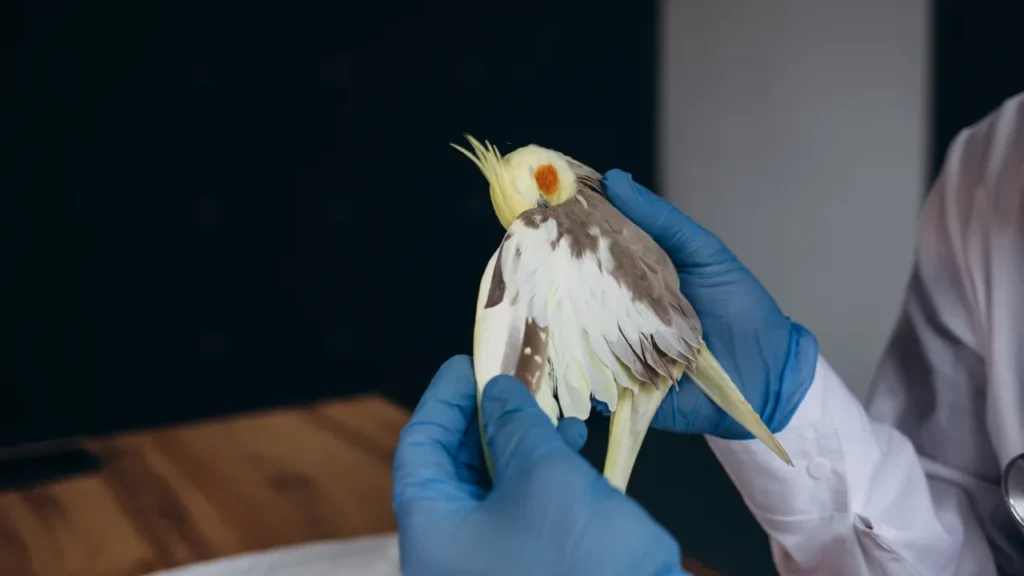
Sudden behavior change in an adult bird deserves a vet visit before behavioral work begins. The conditions that most often present as behavior change:
Pain from arthritis, injury, or gout. Bird bites when handled at a specific location or moves gingerly on the perch. Older birds especially.
Ovarian or reproductive pathology in hens. Bites, screams, chronic egg-laying, cloacal changes, weight loss. Egg binding is a same-day emergency (see egg binding in hen birds); other reproductive pathology needs an avian vet on a routine timeline.
Neurological changes. PDD (avian bornavirus), lead or zinc toxicity, head trauma. Signs include unsteady perching, seizures, head tilt, and behavioral personality change. Same-day vet visit.
Thyroid or metabolic issues. Uncommon but documented in captive parrots; presents as behavioral personality shifts and appetite/weight changes.
Feather-destructive behavior appearing alongside biting or screaming often has a medical driver (giardia, allergy, dermatologic infection, hormonal). Full medical workup before behavioral intervention[1][2].
For any behavior change in a previously stable adult bird, the working order is: (1) vet, (2) bloodwork, (3) then behavioral intervention. If your regular avian vet is not available and you want a starting-point read, an avian televet consult can help you decide whether the pattern warrants an in-person emergency visit or can wait for an appointment.
What never works (and often makes things worse)
Some interventions are widely recommended in old parrot books and internet threads and are actively counterproductive.
Spray bottles. Aversive-conditioning a parrot with water usually amplifies fear, does not shape the specific behavior the owner wants to change, and produces a bird that mistrusts humans holding anything spray-shaped for the rest of its life. Skip.
Cage covering as punishment. Cage covering signals sleep. Using it as punishment confuses the sleep cue and produces a bird whose sleep schedule and stress response both degrade. Cover consistently for sleep; do not use the cover as a consequence.
Tapping, thumping, or flicking the beak. Punishment with the hand teaches the bird that hands are dangerous. Every future step-up, every future handling event, is negotiated on top of that lesson. Skip permanently.
Yelling. Loud reactions are exciting. In many households, yelling reinforces both biting and screaming rather than deterring them.
“Dominance” approaches. The idea that a parrot needs to be shown you are “flock leader” is a dog-training analogy that does not translate. Parrots do not have hierarchical dominance-submission relationships with owners. Interventions built on this idea backfire.
Wing clipping to control biting or screaming. Clipping is a mobility decision, not a behavior intervention. A clipped conure with the same underlying root cause still bites and screams, sometimes worse, because loss of mobility contributes to frustration.
The core principle
Every intervention in this guide is either reducing an environmental driver or reshaping a reinforcement pattern. None of them are about punishing the bird or asserting control. The behavior your conure is showing is a signal about conditions in its environment or in the interaction pattern with you. Address the signal at the source and the behavior changes; punish the signal without addressing the source and the behavior gets worse, often permanently.
Consistency matters more than technique. A mediocre plan applied consistently across every household member for six weeks outperforms a perfect plan applied inconsistently for six months.
A mediocre plan applied consistently for six weeks outperforms a perfect plan applied inconsistently for six months.
FAQ
Why does my conure bite me but not my partner?
Usually a bond-preference issue — see jealousy and rivalry. Sometimes the “unfavored” person is doing something small the bird finds threatening (approaching too fast, hovering over the cage, using a hand posture the bird has come to associate with a bad experience). Have the person the bird avoids do the target-training and treat delivery for a few weeks.
Why does my conure suddenly bite when it never used to?
Sudden change deserves a vet visit — see medical rule-out. Once medical causes are ruled out, look for environmental changes: new pet in the house, moved cage, changed schedule, hormonal onset in a maturing bird, or a household member unintentionally reinforcing a new pattern.
How do I stop my sun conure from screaming so much?
Some of it you cannot stop — sun conures scream as flock calls, and it is species-normal. What you can address: the attention-reinforced portion (see attention-seeking screaming) and the boredom-driven portion (see under-enrichment). If you cannot tolerate the species-normal baseline, the honest answer is that a sun conure may not be the right bird for your household — see the conure vs cockatiel comparison for alternatives.
Is it okay to cover my conure’s cage when it screams?
No, not as a punishment for screaming. Cover consistently for sleep at the same time nightly. If you cover during the day to stop screaming, you teach the bird that screaming produces covering — some conures come to prefer the darker environment and the pattern intensifies.
When will my conure stop biting?
When the root cause is addressed and enough repetitions of the new pattern have accumulated. Usually two to eight weeks for fear-based or cage-territorial biting once the intervention starts. Longer for hormonal or attention-reinforced patterns. Consistency across every household member is the single largest factor.
Should I get a bird trainer or behaviorist?
For sustained problems that have not resolved with the interventions above, yes. Look for someone certified in positive-reinforcement animal training (IAABC-CPBC or similar) rather than “dominance-based” trainers. Barbara Heidenreich’s materials at LafeberVet[3] are the standard practitioner-level reference, and many avian behaviorists offer remote consultations that work well for owner-side coaching.
Can I train an older conure or is it too late?
Older conures are absolutely trainable. Rehomed adult birds who arrive with heavy biting or screaming patterns can learn new patterns; the timeline is longer than it is with a young bird, and the required consistency is higher, but the outcome is achievable. Six months is a reasonable planning horizon for significant behavior change in an adult rehomed bird.
Is biting or screaming a sign my conure hates me?
No. Biting and screaming are signals about specific conditions — fear, territoriality, boredom, hormones, attention patterns, or pain. A bird biting a hand that reaches into its cage is not expressing dislike of the person; it is defending the cage. Read the signals, address the conditions, and the relationship gets better.
References
- Association of Avian Veterinarians. Clinical references and behavioral position papers. https://www.aav.org/
- VCA Animal Hospitals. Feather Picking in Birds. https://vcahospitals.com/know-your-pet/feather-picking-in-birds
- Heidenreich B. Training and behavior articles for companion parrots. LafeberVet. https://lafeber.com/vet/behavior-training-companion-parrots/
- Friedman SG, et al. The Facts About Parrot Behavior and related applied-behavior-analysis materials. https://www.behaviorworks.org/
- Lafeber Pet Birds. Species-specific behavior notes: Sun Conure, Green-Cheeked Conure. https://lafeber.com/pet-birds/species/
- Speer BL, editor. Current Therapy in Avian Medicine and Surgery. St. Louis: Elsevier; 2016. ISBN 9781455746712.