

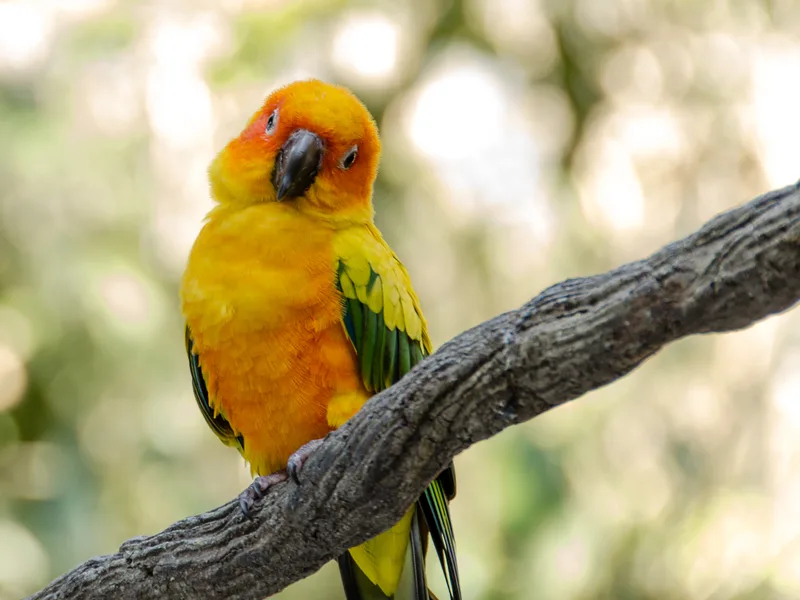
Two questions decide it: how thick are your walls, and how many evenings a week does the bird get? A cockatiel handles thin walls and a busy calendar — more song than screech, and the kind of bird a first-time owner can afford to learn on. A green-cheek asks more on both counts and gives back a small, animated shadow that will follow you around the kitchen for the next two decades.
The sun conures, jendays, blue-crowns, and other Aratingas are a different decision from either alternative. Their call at close range compares to a chainsaw or the front row at a rock concert, and the noise is not a training problem you can solve later. If your walls are thin, if you take work calls from home, or if you have neighbors above, below, or beside you, read the noise section twice before you go looking at yellow chest feathers on Instagram.
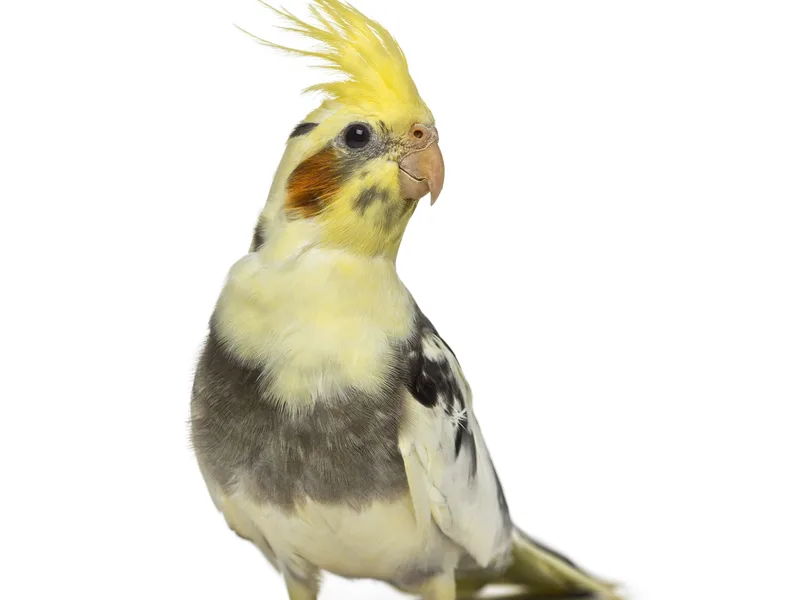
Choose a cockatiel if you live in an apartment, work from home, want a bird that whistles more than screams, or you’re new to parrots and looking for a lower-drama companion. Quieter, more forgiving of husbandry mistakes, less demanding of an owner’s evening.
Choose a green-cheek conure if you want a bird with a bigger personality, don’t mind moderate chatter, will be home enough hours to satisfy the bond, and can commit to a twenty-to-thirty-year relationship. More interactive, more clownish, physically hardier than a cockatiel.
- Noise: the factor buyers underestimate
- Talking and vocalization
- Size, cage, and space
- Lifespan and long-term commitment
- Temperament and personality
- Care difficulty and vet access
- Cost of ownership
- Who should choose which
Conure vs cockatiel at a glance
| Attribute | Green-cheek conure | Sun/jenday conure | Cockatiel |
|---|---|---|---|
| Adult length | 10 in / 26 cm | 12 in / 30 cm | 12–13 in / 30–33 cm |
| Adult weight | 60–80 g | 100–120 g | 80–100 g |
| Average lifespan (captive) | 10–15 years | 15–25 years | 15–20 years |
| Well-cared-for maximum | 25–30 years | 30–40 years | 25–30 years |
| Noise level | Moderate chatter, occasional screech | Very loud, chainsaw-level screech | Low-moderate whistles and hisses |
| Talking ability | A few words, muffled | A few words, very loud | Clear whistles, some words in males |
| Cage minimum (L×W×H) | 24 × 24 × 24 in | 24 × 24 × 30 in | 24 × 18 × 24 in |
| Care difficulty | Beginner-friendly | Intermediate | Beginner-friendly |
| Purchase price (US, 2026) | $250–500 | $500–900 | $150–350 |
| Setup cost (cage + supplies) | $350–700 | $500–1,000 | $300–600 |
| Cuddle factor | High | High | Medium |
| Independent play | Medium | Medium | Higher |
| Good with children? | With supervision | Not typically | Yes, with supervision |
| Apartment-compatible? | Usually | Rarely | Yes |
The most useful frame for the table: green-cheeks and cockatiels compete for the same buyer. Suns, jendays, and the other Aratingas are a different decision, a bird you say yes to after reading the noise section twice, not before.
Noise: the factor most buyers underestimate
Every experienced parrot owner will tell you the same thing. The photos on breeder pages hide the sound the bird makes; a five-minute video with your phone volume up all the way is a fairer test.
Buy for volume first, look second.
Cockatiels. Adult males whistle, warble, and often pick up short vocalizations that resemble wolf whistles, doorbells, or phone rings. The loudest sound she makes at close range — standing next to the cage while she’s whistling at you — sits in the range of ordinary conversation, sometimes rising to vacuum-cleaner volume during the morning and evening flock calls. Hens are quieter still. This is a bird you can keep in an apartment, take work calls near with the door closed, and share a wall with a neighbor over.
Green-cheek conures. A stack of small vocalizations across the day: chatters, quiet chirps, mumbled talking attempts, an occasional excitement screech when you walk in the front door. Her loudest single call — the surprise screech, not the day-long chatter — is louder than a cockatiel but nothing like a sun conure. Owners describe green-cheeks as noticeably quieter than the other pet conures. Apartment-compatible in most buildings, sometimes with a courtesy call to a shared-wall neighbor.
Sun, jenday, nanday, and other Aratinga conures. These are the loud ones. Their call at close range compares to a chainsaw at arm’s length or the front row of a rock concert. Sun conures in particular scream in bursts of five to ten seconds, several times a day, most reliably at dawn, at dusk, and when a household member walks back in the door after being out. It is not a training problem you’ll solve in year two. It is the species’ natural flock-contact vocalization, and behavioral interventions blunt frequency without eliminating the call.
Ask any parrot-rescue operator. Aratinga conures show up in surrender populations out of proportion to how many people keep them, with the peak clustering in years two through four as adult vocalizations come in. Cockatiels and green-cheeks don’t show the same pattern. If your walls are thin, if you have neighbors above, below, or beside you, or if you take work calls from home, this is the whole reason to choose a different bird.
Talking and vocalization
Both species are limited talkers by parrot standards. Neither will develop a large vocabulary the way an African grey, an Amazon, or a quaker parrot does. If speech is the main thing you want out of a bird, neither species is the right buy. A budgie (surprisingly capable), a quaker, or an Amazon fits better.
Cockatiels, especially males, are better whistlers than talkers. They pick up short melodies, doorbell tones, phone ringtones, and occasional short phrases like “pretty bird” or the household member’s name. The voice is small and clear. Females are quieter and less likely to develop mimicked speech.
Conures occasionally learn a few words but deliver them at high volume and often muffled by the beak shape. Green-cheeks and sun conures both can learn to say “hello,” their own name, and short greetings, but a fluent talker is not what any conure is going to grow into.
Size, cage, and space
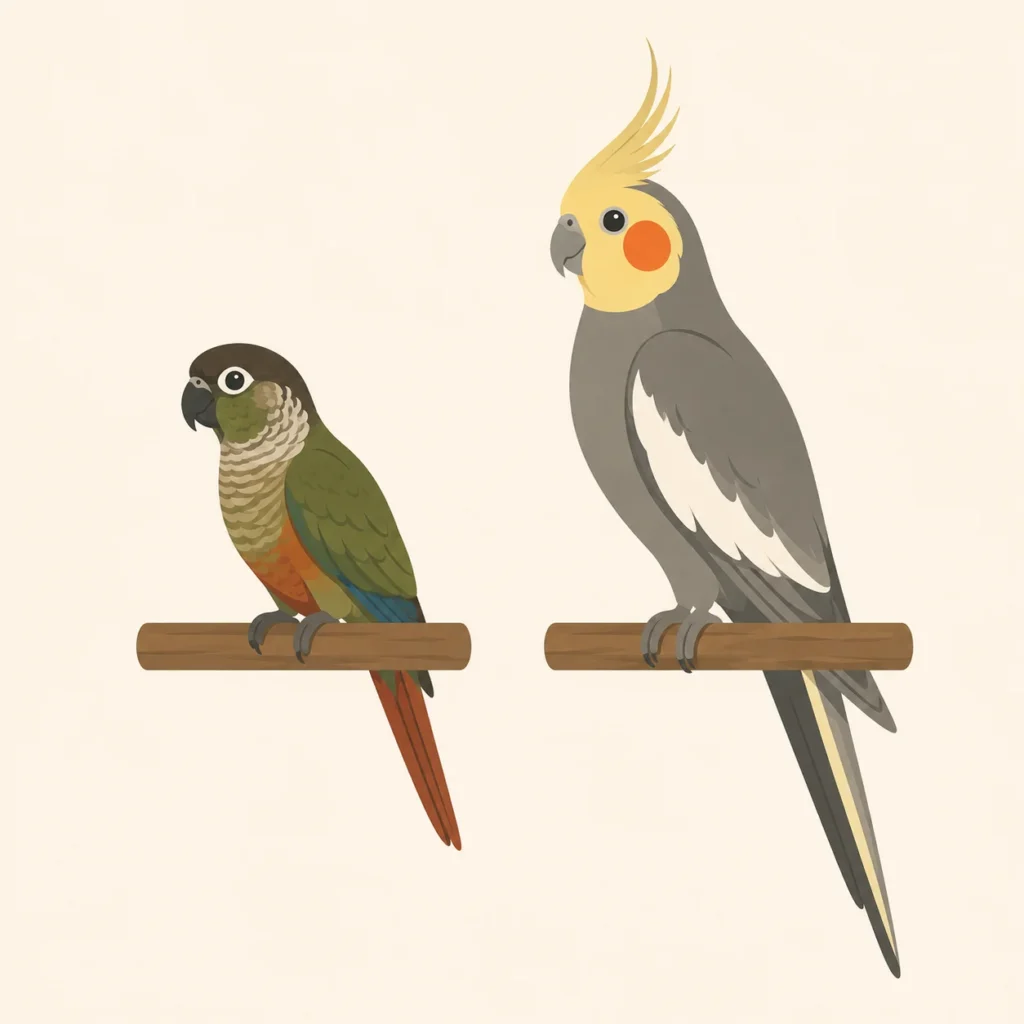
Cockatiels are longer than green-cheeks, twelve to thirteen inches against ten, but lighter and more slender. The long tail is what makes them look bigger. A 24 × 18 × 24 inch cage is the working minimum for a single cockatiel, and wider is better than taller.
Green-cheek conures are compact, chunky little birds at sixty to eighty grams — about the weight of a large chicken egg to a small orange in your palm. Same 24 × 24 × 24 inch cage minimum. Bar spacing should sit between 1/2 and 5/8 inch (small enough that her head can’t slip through the gap between two bars and get stuck); cockatiel-appropriate spacing of 5/8 to 3/4 is a hair too wide for a small Pyrrhura head — the genus name for the smaller-skulled conures that includes the green-cheeks.
Sun and jenday conures need more room, 24 × 24 × 30 inches minimum, and a 30 × 30 × 36 cage is meaningfully better for the bird’s welfare. They’re more active than either alternative and use every inch of space they get.
For apartment layouts, cockatiels fit the footprint most comfortably. Green-cheeks are close behind. Aratingas need a larger dedicated cage and enough floor space around it that a bird out for the evening doesn’t spend the hour knocking into furniture.
Lifespan and long-term commitment
If lifespan is a live factor in the decision, because of your own life stage or because you want the honest number before you start, a cockatiel and a green-cheek are close, and a sun or jenday is meaningfully longer.
Temperament and personality
This is where the species diverge the most, and where an honest description helps buyers land on the right bird.
Cockatiels are gentle, curious, and typically less physically clingy than conures. They enjoy being near their person but are content to sit on a play stand or a shoulder rather than demanding cuddles. They are among the best pet birds for households with children old enough to handle a bird gently, and they are famously good at entertaining themselves when their person is at a desk or on a call. The typical cockatiel complaint isn’t aggression. It’s night frights, a species-specific tendency to thrash in the dark when startled, occasionally injuring the wing tips against the cage bars. A small night light in the sleep cage prevents most of it.
Green-cheek conures are cheekier and more physically interactive, and more prone to “beaking,” the mouthy exploration that becomes real biting if not shaped early. They will roll onto their back in your palm, burrow into shirts and hoodies, and hang upside-down from your fingers for the fun of it. They are also the conure most likely to develop cage-territoriality biting in year two if the trust window in weeks two through four is mishandled. The conure biting and screaming guide covers the pattern and the interventions that reliably reverse it.
Sun and jenday conures are the personality-forward Aratingas: dramatic, loud, expressive, deeply bonded to their preferred person, and often mistrustful of everyone else in the household. A bonded sun is one of the most affectionate small parrots you can keep. A sun conure whose preferred person is out of sight is one of the loudest.
Care difficulty and vet access
Both species are considered beginner-friendly relative to larger parrots (macaws, cockatoos, African greys), but the way they forgive mistakes differs.
Before you buy: check that a vet in your town will actually see the bird
The one differentiator most bird-comparison articles skip is the practical one: whether an avian vet exists near you, and whether that vet will take on the species you’re considering. Search the Association of Avian Veterinarians directory for your zip code before you finalize the choice. Call one or two of the results and ask two questions. Do you see cockatiels? Do you see conures? If the answer differs by species, that changes which bird belongs in your house. In much of the US, the nearest avian vet is a two-hour drive at least, and a live avian televet consult is the working fallback for anything that isn’t a same-day emergency. Vet Corner covers how to find an avian vet and when a televet is enough. Both species are prone to sudden, silent illness. Birds evolved to mask sickness because a wild parrot that looks sick gets eaten, and the phone number of a vet who will see her is worth more the day you need it than every other line item on the setup list.
Cost of ownership
Setup runs, roughly:
Ongoing costs are close across all three, at roughly $20–40 a month for pellets, fresh food, and supplements. Annual wellness exams run $80–200; bloodwork adds $150–300 when included. Any illness event can run $500 to $2,500 depending on diagnosis and treatment. A conservative annual budget with no emergencies is roughly $500–800 for any of the three species. A realistic budget that assumes one significant health event across the bird’s lifespan lands closer to $1,500–3,000 in that year.
The purchase-price gap between a $250 green-cheek and a $700 sun conure disappears inside the first year. Don’t let it drive the choice.
Who should choose which
If none of the three fits — if talking is what you’re after, or the household is empty for ten hours a day, or fifteen years is longer than you can plan for — the honest answer is that neither species is the right bird right now. A budgie handles speech better than either. A pair of finches handles a busy household better than either. And a decision made carefully in the wrong direction is easier to reverse before the carrier lands on the kitchen table than after.
Conure vs cockatiel FAQ
Which is louder, a conure or a cockatiel?
A cockatiel is quieter than any conure. Among conures, green-cheeks are closest to cockatiel volume. Sun and jenday conures are dramatically louder, roughly the difference between a coffee grinder and a chainsaw.
Which is smarter, a conure or a cockatiel?
Both are similar in intelligence, comparable to a small dog, sensitive to voice tone, capable of learning target training (following a chopstick or target stick with the beak on cue — the foundation trick that teaches every other trick) and short behavior sequences. Cockatiels are marginally better at whistled mimicry; green-cheeks are marginally better at solving foraging puzzles. Neither is dramatically brighter than the other.
Do cockatiels or conures live longer?
Green-cheek conures average shorter than cockatiels (10–15 vs 15–20). Sun conures average about the same or slightly longer than cockatiels (15–25 vs 15–20). Blue-crown, jenday, and other larger conures average meaningfully longer than cockatiels (20–30 vs 15–20). See the conure lifespan guide for the sub-species picture.
Can a conure and a cockatiel live together?
Not in the same cage. Cockatiels are typically the gentler of the two; a green-cheek sharing a cage will out-compete a cockatiel for food and perches. Separate cages, supervised out-of-cage time, and a quarantine before introduction is the working protocol. Never house a sun or jenday conure with a cockatiel. The size and noise disparity is too great.
Which one is better with kids?
Cockatiels, in almost every household. Green-cheeks can work with older, careful children. Sun and jenday conures are not usually appropriate for households with young children. The beak strength and the unpredictability under stress create injury risk.
Are conures more expensive than cockatiels?
Purchase prices differ; cockatiels are the cheapest, sun conures the most expensive. Ongoing costs are close across species. The gap is small enough that it should not drive the decision.
Which is more likely to bite?
Green-cheek conures are more likely to develop cage-territoriality biting in year two than cockatiels are. Cockatiels are more likely to hiss, back away, or nip briefly rather than deliver a full bite. Sun conures bite hard when they choose to, but are often more predictable about their warning signals. The conure biting and screaming guide is the diagnostic frame.
Which settles better after moving to a new home?
Cockatiels, most of the time. A rehomed adult cockatiel typically settles inside a few weeks. Green-cheeks take longer and rely more on the new owner working through the trust-building routines from scratch. Sun and jenday conures have the hardest time with a change of home; a stress-plucking response — where the bird tears out her own feathers in response to the anxiety of the move — is common, and the recovery timeline can run months.
Should I get one bird or two?
If you’re home most of the day, one bird bonded closely to you is a valid choice. If you’re out eight hours or more daily, two birds keep each other company. Two of the same species usually get along; mixed-species pairs are riskier and depend on individual temperament. The conure care guide covers the solo-versus-pair reasoning in more depth.
References
- Lafeber Pet Birds. Green-Cheeked Conure Species Profile. Lafeber Company, accessed August 2026. https://lafeber.com/pet-birds/species/green-cheeked-conure/
- Lafeber Pet Birds. Cockatiel Species Profile. Lafeber Company, accessed August 2026. https://lafeber.com/pet-birds/species/cockatiel/
- Merck Veterinary Manual. Nutritional Diseases of Pet Birds. Merck & Co., accessed August 2026. https://www.merckvetmanual.com/exotic-and-laboratory-animals/pet-birds/nutritional-diseases-of-pet-birds
- Association of Avian Veterinarians. Find-a-Vet Directory. AAV, accessed August 2026. https://www.aav.org/