
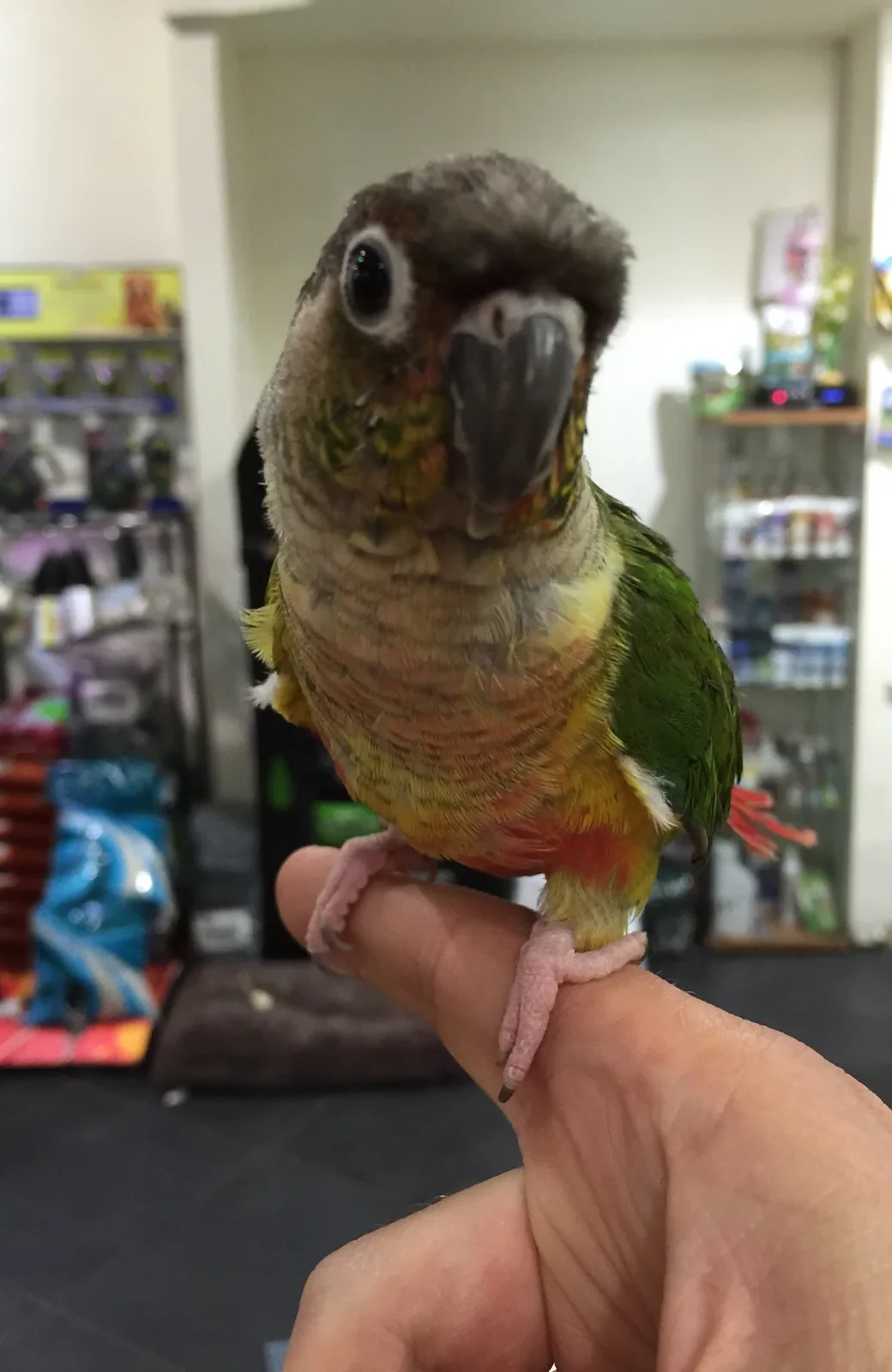
What she eats, how she treats your hands, whether she calls out when you leave the room or screams: all of it takes shape between the day the carrier lands on the kitchen table and the day, twelve weeks later, when she stops treating your presence as a change and starts treating it as home. The small choices you make in that window become the defaults she runs on for the next twenty to thirty years.
What follows is the walk-through: what to put in the room before she arrives, what her first day looks like, what to do in week one and what to change in weeks two through four, and what an ordinary, settled month three morning looks like once the two of you have found the rhythm.
If your bird has been home for months already and you’re reading this after the fact, the chronological pieces still apply; a settled adult runs on the routines the first ninety days build. Month three and beyond is where the daily pattern lives. And for the lifespan reasoning, see the conure lifespan guide.
- Before the bird comes home
- Day one: home
- Week one: acclimation
- Weeks two through four: building trust
- Month three and beyond
- What conures eat, day to day
- The five mistakes that shorten conure lifespans
- When to call the vet
Before the bird comes home
Set the room up before the carrier arrives. A conure walking into a finished environment settles inside a day; a conure whose owner is still assembling perches at hour thirty-six spends her first week reading the room as unstable.
The cage. For a small Pyrrhura like a green-cheek, a minimum of 24″ × 24″ × 24″ (a two-foot cube, about the footprint of a nightstand) with 1/2″ to 5/8″ bar spacing (roughly the width of an adult’s pinky fingernail — narrow enough that her head can’t wedge between two bars). For an Aratinga (a sun, jenday, nanday, or blue-crown), 24″ × 24″ × 30″ is the working minimum — the same footprint but roughly waist-high — and bigger is better within reason. Wider matters more than taller; conures move laterally through their space the way a squirrel moves through a hedge, not vertically the way a finch moves through a tree. Powder-coated steel is standard. Skip the tall, narrow “parrot towers” some big-box stores sell; they waste vertical space the bird will not use and starve the horizontal room she will.
Perches. Three or four, in varying diameters and materials. At least one natural-branch perch (manzanita, java wood, or clean untreated apple, willow, or elm), sized so her toes wrap roughly two-thirds of the way around. A rope perch for softer standing. Skip the sandpaper “grooming” perches sold as beak and nail conditioners; they abrade foot pads and are a documented bumblefoot risk factor. Our bumblefoot page covers the foot-health long game and the safe woods list.
Food and water bowls. Stainless steel, three of them: pellets, fresh food, water. Position at perch level, not on the cage floor. Add a second water bowl on the opposite side of the cage during hot months so a knocked-over bowl doesn’t mean a dry day.
A cage cover. Any breathable cotton throw, wide enough to cover front and sides without draping into the cage. Not plastic. Respiration matters more than the room’s aesthetics.
Toys. Three to five to start, of varying types: one destructible (yucca, palm-leaf, or balsa shredder), one foot toy, one foraging puzzle. Rotate weekly so novelty holds.
A gram scale. The single most useful bird accessory most owners don’t buy. A digital kitchen scale with a flat platform, accurate to one gram, is enough. Birds mask illness by instinct, often for days or weeks before an obvious symptom shows,[6] and a weekly weight log is the most useful data you can hand your vet at every visit for the rest of her life.
A carrier. A small hard-sided travel carrier. The ones sold for small dogs and cats work if you add a low perch or a folded towel for footing. You will use it on day one and at every vet visit for the next twenty years.
Pellets. Three brands avian veterinarians consistently name in practice: Harrison’s, Roudybush, and TOPs. Buy a small bag of whichever the breeder or previous owner was feeding, and a small bag of your target pellet if they differ.
A named avian vet, identified before the bird arrives. Search the Association of Avian Veterinarians directory, call, and confirm they see conures and are accepting new patients. Do this before there’s a crisis, not during one. If your area has no avian vet (and in most of the country, it doesn’t), a live avian televet consult is the working fallback for non-emergency questions in the first months.
What not to buy. Cage-hung mite protectors (ineffective, and they release chemicals into the bird’s air), sandpaper perches, seed-only mixes as the primary diet, non-stick anything, mirrors for a single conure (they promote hormonal fixation on the reflection), and any cage marketed as a “starter cage” that measures under 20″ in any dimension.
Day one: home
She arrives stressed. Even a well-socialized young conure has just come through a car ride, a change of address, and a change of the people in her life. Day one is reduce stimulation, let her set the pace. Nothing more.
Cage placement matters. A room the household spends time in (living room or home office) is right. A corner gives her a two-sided visual wall; middle-of-the-room placement leaves her with three hundred and sixty degrees of visual threat. Not directly in front of a window (predator sightlines) and not adjacent to a kitchen (PTFE fumes). Cage top roughly at your seated head height.
Turn off any ceiling fans. Cover mirrors if she can see them. Move any non-stick cookware out of the kitchen or, at minimum, don’t cook on day one. PTFE fumes — PTFE is polytetrafluoroethylene, the slick chemical layer that gives non-stick pans, waffle irons, and heat-lamp bulbs their coating — released from any of those surfaces when they overheat are the household toxin most likely to kill a pet bird suddenly, often within minutes and often with no warning odor a human can smell.[4][8] Self-cleaning oven cycles, irons and ironing-board covers, waffle irons, and heat lamps with PTFE coatings are other sources people miss.[8] The conure lifespan guide covers the mechanism.
Cover the cage at whatever time you plan to be her bedtime. Most keepers land on 8 or 9 PM. Twelve hours of dark, on a consistent schedule, is the target from day one. Light-cycle stability is what prevents most of the hormonal problems that show up in year two — chronic egg-laying in hens (her body reads long days as breeding season and refuses to stop), hormone-driven aggression, and feather-plucking on the chest and thighs where a bird’s mating displays start.[5]
Sit near, talk quietly, watch. That is the whole lesson plan for day one.
Week one: acclimation
She’ll eat, drink, preen, and sleep more openly by the end of day two. By day three she should be moving between perches, chewing on toys, and vocalizing at least a little. If by day four you’re seeing puffed-up posture, closed eyes during the day, no interest in food, or tail-bobbing while breathing, that’s a warning sign. Call the vet.
Otherwise, week one’s job is habituation. By day seven she’s stopped reading your presence as a threat. That’s it. No taming, no training, no shoulder rides, no photos.
Daily rhythm. Uncover at whatever time you’ve picked for morning, ideally the same time every day. Refresh food and water. Talk to her from a few feet away for five or ten minutes, then go about the morning. Return in the evening; talk again from a few feet away while you move around the room. Cover at the same time at night.
Introducing hands. By day three or four, most young conures accept a hand resting still on the outside of the cage bars without startling. Do that a few times a day for a few minutes. By day five or six, most will accept the same hand slowly moving to place a millet spray inside the cage. Don’t reach toward the bird with the hand. Approach the food bowl, place the millet, withdraw. This is how she learns your hand is not a predator.
Diet on hold. No pellet transition yet. Feed what she was eating before, plus a small amount of fresh vegetables (romaine, dark leafy greens, chopped bell pepper, a slice of cucumber) in a separate bowl each day. If she ignores them, that’s fine; repeated offering is how bird brains normalize new food. Don’t remove seeds.
What “acclimated” looks like at day seven. She eats openly when you’re in the room. She vocalizes when you enter and when you leave. She moves toward you rather than away when you approach the cage. If you’re seeing all three, week one worked. If you’re not, week one becomes week two; extend the acclimation window and don’t rush. Slower is faster on this timeline.
Weeks two through four: building trust
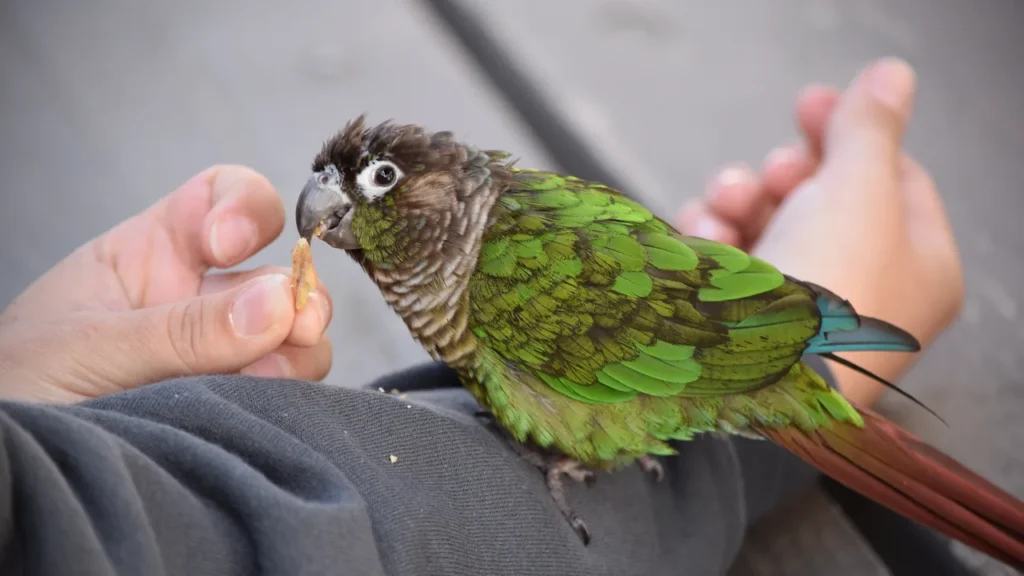
The trust window opens now. The technique used across most avian behavior work is target training with a bridge — the “bridge” is the marker word or clicker that fills the split second between the behavior and the treat, so she learns which specific thing earned the reward — and LafeberVet’s own behavior primer builds on it as the least intrusive, most ethical route into cooperative handling. The short version: use a chopstick or plain wooden dowel as a “target”; when she touches her beak to the target, mark the behavior with a consistent short word (“good”) — that word is the bridge — and immediately reward with a millet piece or a small nut sliver. Sessions of two or three minutes, several times a day. Within a week most conures will follow the target from perch to perch. Within two, most will step onto a hand offered next to the target.
This is the foundation for every later interaction. A bird that has been grabbed, chased, or “toweled up” to be moved learns instead that human hands are threats to be avoided, and every interaction after becomes a negotiation. Year two is when the difference between the two paths shows up as a temperament, and the pattern is hard to un-teach.
A target-trained bird accepts step-up, moves willingly between perches, and can be recalled off a shoulder — all without force.
Out-of-cage time starts at week two, in a bird-proofed room, with the cage door open. Don’t lift her out. Open the door and let her come out on her own. Some conures step out on day one of an open door; others take a week. Both are normal. Bird-proofing means: ceiling fans off, windows and mirrors covered with cloth or curtains, doors to unsafe rooms closed, other pets excluded, no cooking happening anywhere in the house during the session. First out-of-cage sessions are twenty to thirty minutes, ending with the bird returning to the cage on her own for a treat, never with a chase.
Diet transition begins around week three. By this point she’s eating openly, her baseline weight is established, and her gut is stable enough for change. Mix a small amount of pellet into the existing seed mix, starting at roughly 10% pellet, 90% seed. Weigh her every three or four days. If weight holds, increase the pellet proportion by 10% weekly. If weight drops more than 5% — and 5% of a 60-to-140-gram conure is three to seven grams, roughly one to two US nickels’ worth — back off the pellet ratio and try again in a week. Full transition often takes four to eight weeks and occasionally longer. Never withdraw seeds abruptly and never fast a bird to force pellet acceptance; hepatic lipidosis (fatty liver disease — the same condition force-fed geese develop) and hypoglycemia (a blood-sugar crash; small birds run through their reserves fast and can collapse within hours of skipped meals) are the risks.[3] The green-cheek lifespan page covers the transition mechanics in more depth.
First vet visit. Book the wellness exam for around week three or four. A baseline weight, physical exam, and (for an adult bird, or where the bird’s history is uncertain) a bloodwork panel establish the reference point every future visit will be compared against. Bring the weight log you’ve been keeping. This first-visit baseline is disproportionately valuable; it is what makes bloodwork drift interpretable a year, five years, and fifteen years from now.
Month three and beyond: the settled routine
By month three the household should have found a rhythm the bird recognizes and repeats. This is what an ordinary day with a settled conure looks like.
Daily. Uncover at the same morning time. Fresh water in both bowls. Chopped vegetables and a small amount of fruit in the fresh-food bowl: romaine, kale, cilantro, broccoli, bell pepper, snap peas, carrot, a few blueberries, occasional apple with the seeds removed. Pellets available all day. Two to three hours out-of-cage time in the evening for a Pyrrhura; three to four for the more active Aratingas. Cover at the same time nightly for ten to twelve hours of dark. Weigh once a week, at the same time on the same day, and log it.
Weekly. Rotate one or two toys out for fresh ones. Clean perches with a bird-safe cleaner (F10 — a hospital-grade veterinary disinfectant sold in small bottles at avian-supply shops — or a dilute white vinegar solution, roughly one part vinegar to four parts water). Full cage tray change with a fresh liner. Wash food and water bowls in hot water.
Monthly. Deeper cage clean. Hose the whole cage down if you have outdoor space, or scrub in a bathtub with F10 or diluted vinegar, rinsed thoroughly and dried before she goes back in. Trim toenails only if her natural perch use isn’t wearing them down (most healthy conures on varied perches never need a trim). Skip beak trimming unless a vet flags an overgrowth; a normally-conditioned conure beak stays in shape on its own.
Annually. Wellness exam with the avian vet. Weight review, physical exam, and, for adult birds, a repeat bloodwork panel to catch drift in liver enzymes, kidney values, and calcium — the blood markers that climb first when the liver is under strain, fall first when the kidneys start to fail, or drop out of range when a laying hen is running out of stored calcium. After age ten, semi-annual bloodwork is the working standard. The conure lifespan guide covers the reasoning on early detection.
What conures eat, day to day
A settled adult conure eats a formulated pellet as roughly 60–80% of daily calories — most of what fills her food bowl on a given day — fresh vegetables and small amounts of fruit as 15–30% (a small handful of chopped produce), and seeds or nuts as treats and training rewards rather than staples. That composition is the single largest owner-controllable factor in whether your bird reaches the top or the bottom of her species’ lifespan range.
Foods that are toxic to conures. Cover once, remember always. Avocado (the persin in the skin, flesh, and pit is cardiotoxic — persin is a natural fungicide the avocado tree makes for itself; harmless to humans, it damages the heart muscle in birds — and can kill a small parrot within hours), chocolate, caffeine, alcohol, onion, garlic, salt, apple seeds and stone-fruit pits (cyanide precursors — the seed coat contains a compound that breaks down into small amounts of cyanide when chewed; a stray apple seed won’t hurt her, but a chewed peach or cherry pit is the real risk), raw dried beans, and anything moldy.[3][4] Xylitol (the sugar substitute in some gums and baked goods) has been proposed as toxic to birds, and there is no reason to test the theory. If your bird eats any of these, treat it as a same-day emergency: call your avian vet or an emergency exotic vet immediately.
The seed problem. Sunflower and safflower seeds are essentially chips for a conure: high fat, low protein, delicious, and addictive if allowed to be the main calorie source. Green-cheeks and other Pyrrhuras will preferentially eat sunflower over anything healthier if given the choice. So will Aratingas, and it is harder to reverse in an adult bird who has been seed-fed for years. Seeds are treats, not staples. See the green-cheek lifespan page for the diet-transition mechanics.
Water. Fresh daily, changed twice on hot days. Filtered is fine; tap is fine in most municipal systems.
The five mistakes that shorten conure lifespans
Vets see the same five patterns in birds that reach year two in bad shape. Diet, PTFE, and light-cycle stability are the three we’ve already covered; these are the ones the first year hides.
When to call the vet
Three tiers of urgency. It’s worth keeping this list somewhere visible in the first year, because the moment you need it isn’t the moment you’ll want to be searching for it.
Now: same-day emergency. Drive to an emergency exotic vet if your regular one is closed.
Within twenty-four to forty-eight hours. Book an appointment.
- A sudden change in droppings that holds across a full day
- Weight loss of 5–10% or more
- Loss of appetite lasting more than twelve hours in a healthy adult bird
- Fluffed posture and reduced activity across a full day
- New feather-destructive behavior
Wellness and non-urgent.
- Annual exam (semi-annual after age ten)
- New-owner baseline visit
- Behavior questions (biting, screaming, plucking) once medical causes are ruled out. The conure biting and screaming guide is the diagnostic frame.
For the middle tier, the questions that don’t rise to same-day emergency but leave you uneasy about waiting a week, a live avian televet consult is the working option, especially in the parts of the country where no in-person avian vet is within reasonable drive. If your search is coming up empty locally, Vet Corner covers how to find an avian vet and when a televet is enough.
Conure care FAQ
How long does it take to bond with a new conure?
Two to eight weeks for a young hand-raised bird whose owner follows the target-training approach and doesn’t rush. Six months or more for a rehomed adult, a bird with a history of grabbing or chasing, or an owner trying to shortcut the trust window. Slower is faster on this one.
Can I keep just one conure, or does she need a companion?
A single conure with two to four hours of daily human interaction, adequate enrichment, and reliable out-of-cage time does fine. A single conure in a household where nobody is home during the day and there are no other birds is at real risk of feather-destructive behavior. If you’re out more than eight or nine hours daily and can’t provide compensating enrichment, a second bird is a better answer than leaving the first alone.
What’s the best conure for a first-time bird owner?
Green-cheek conures and other small Pyrrhuras (maroon-bellied, crimson-bellied, black-capped) are the beginner-friendliest: quieter than the other pet conures, more forgiving of husbandry mistakes, and smaller. Sun and jenday conures are gorgeous but loud enough to strain apartment living. The conure vs cockatiel comparison lays out the fuller decision frame.
How often should I let my conure out of the cage?
Every day if at all possible. Two to three hours minimum for a Pyrrhura; three to four for an active Aratinga. Exact timing matters less than consistency; a bird that gets out daily behaves better than one who gets out sporadically.
How do I clip a conure’s wings, or should I?
This is a real judgment call, and one worth talking through with your avian vet on the first visit. A flighted conure is more physically fit, more emotionally regulated, and less prone to obesity and behavioral problems. She is also at higher risk of window strikes, escape events, and household accidents. Clipping reduces the risks at the cost of the benefits. If you clip, have a professional do the first clip; a botched job at home can damage feather follicles for life.
When can I trust my conure not to bite?
Never entirely. Every parrot bites eventually. But a target-trained bird whose warning signals you read well, in an environment set up to avoid the situations that provoke biting, will bite so rarely that “trust” is the right word for it. The conure biting and screaming guide is the diagnostic and intervention frame.
References
- Lafeber Pet Birds. Green-Cheeked Conure Species Profile. Lafeber Company, accessed August 2026. https://lafeber.com/pet-birds/species/green-cheeked-conure/
- Association of Avian Veterinarians. Find-a-Vet Directory. AAV, accessed August 2026. https://www.aav.org/
- Merck Veterinary Manual. Nutritional Diseases of Pet Birds. Merck & Co., accessed August 2026. https://www.merckvetmanual.com/exotic-and-laboratory-animals/pet-birds/nutritional-diseases-of-pet-birds
- VCA Animal Hospitals. Teflon (Polytetrafluoroethylene) Poisoning in Birds. VCA, accessed August 2026. https://vcahospitals.com/know-your-pet/teflon-polytetrafluoroethylene-poisoning-in-birds
- Merck Veterinary Manual. Reproductive Diseases of Pet Birds. Merck & Co., accessed August 2026. https://www.merckvetmanual.com/exotic-and-laboratory-animals/pet-birds/reproductive-diseases-of-pet-birds
- VCA Animal Hospitals. Recognizing the Signs of Illness in Pet Birds. VCA, accessed August 2026. https://vcahospitals.com/know-your-pet/recognizing-the-signs-of-illness-in-pet-birds
- Speer BL, Murad JW. Psittacine Behavior, Handling, and Restraint. LafeberVet, accessed August 2026. https://lafeber.com/vet/psittacine-behavior-handling-restraint/
- Merck Veterinary Manual. Toxicoses of Pet Birds. Merck & Co., accessed August 2026. https://www.merckvetmanual.com/exotic-and-laboratory-animals/pet-birds/toxicoses-of-pet-birds